How to Add TMS to Your Psychiatry Practice: A Startup Guide

Adding transcranial magnetic stimulation (TMS) to a psychiatry practice is one of the clearest ways to expand what you can offer patients who have not responded to medication, while building a durable, insurance-reimbursed service line. It is also a real operational project. This guide walks through the decisions that determine whether a TMS program launches smoothly or stalls: the device and business model, the physical space, the staffing and training, the reimbursement path, and the first patients. Each has a dedicated deep-dive linked below; start here for the full picture.
What does it take to offer TMS?
At a minimum, a TMS program needs four things: an FDA-cleared device, a suitable treatment room, at least one trained operator supervised by a prescribing physician, and a billing path — either insurance reimbursement or self-pay. Everything else is optimization. The reason programs vary so much in cost and timeline is that each of those four elements can be set up leanly or expensively, and the choices interact.
The encouraging part is that the barriers that used to make TMS a major capital project have come down. Devices that once required a six-figure purchase and a dedicated procedure suite are now available on monthly leases and in compact form factors that fit an existing exam room. A single clinician with one operator can run a functioning program. That shift is why solo practices and small groups, not just large behavioral-health centers, are now launching TMS.
Step 1: Choose your device and business model
The device decision and the financial decision are the same decision. TMS systems are acquired in one of three ways: outright purchase, leasing, or pay-per-use (where the manufacturer charges a fee for every session delivered). Each shapes your margin structure for years, so it deserves the most scrutiny.
Purchasing means a large upfront cost but no recurring manufacturer fee. Pay-per-use lowers the entry cost but takes $60–$100 out of every treatment you deliver, indefinitely. Leasing sits between them: a predictable monthly cost, no per-session fees, and far less capital at risk. For a new program that cannot yet forecast its volume, a lease with no per-session fees keeps the downside contained while you build a patient base.
This is the highest-stakes choice in the whole launch, so we cover it in depth — including how to model break-even — in TMS Business Models Compared: Lease vs. Buy vs. Pay-Per-Use. For a device-by-device breakdown, see FDA-Cleared TMS Devices Compared.
Step 2: Prepare the treatment space
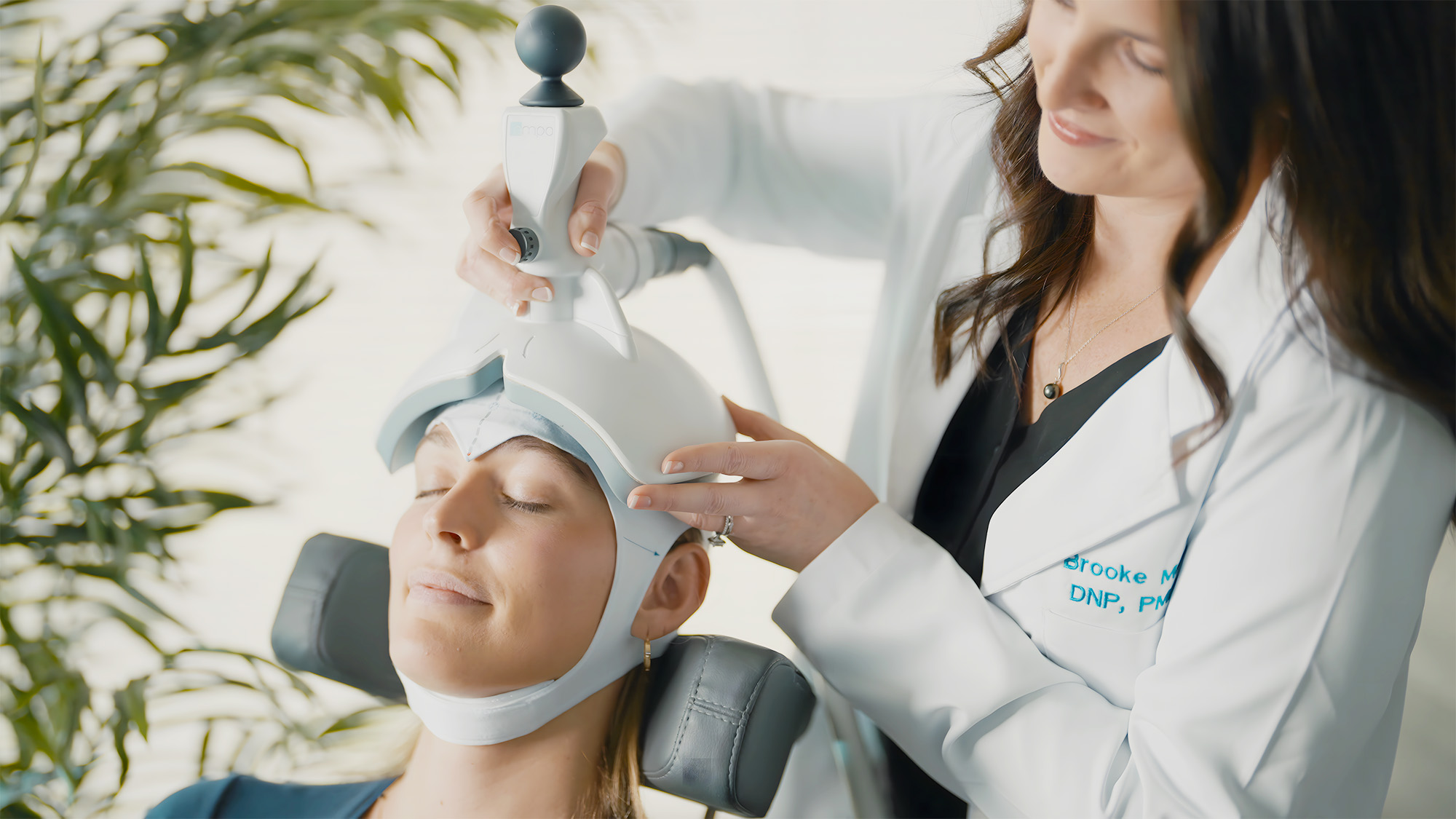
TMS does not require a surgical suite. It requires a quiet, private room with space for the device, a reclining treatment chair, and the operator to work comfortably beside the patient. Practices launching on compact systems routinely convert an existing exam or consultation room rather than building out a dedicated space, which removes one of the largest historical barriers to entry.
A workable setup is straightforward: a stable surface for the device, a comfortable reclining chair the patient can sit in for the length of a session, reliable power, and enough room for the operator to position the coil and move around the chair. Because sessions on accelerated and theta-burst protocols can run as short as a few minutes, a single room can serve a surprising number of patients per day. The full checklist — room dimensions, furniture, power, and the small equipment that is easy to forget — is covered in the staffing and setup guidance below.
Step 3: Staff and train the program
A TMS program runs on two roles: a prescribing and supervising physician, and a trained operator (often a technician, nurse, or medical assistant) who delivers the daily sessions. In small practices, one person may cover more than one role. The critical point is that under-staffing is one of the most common reasons a new program fails to get off the ground — clinics that acquire a device but cannot dedicate someone to run it often stall before their first commercial treatment.
Ampa One training is fast. A capable operator can be trained in a single focused session, reinforced with video training and remote support, rather than a multi-week certification. Plan staffing before the device arrives, not after. We cover roles, training timelines, and how to avoid the staffing gap that derails launches in Staffing and Training a TMS Program.
Step 4: Set up reimbursement and billing
TMS for major depressive disorder is widely covered by Medicare, Medicaid (state-dependent), and most major private insurers, which is what makes it a sustainable service line rather than a niche cash offering. Coverage almost always requires prior authorization and documentation that the patient has not responded to prior antidepressant trials.
Before you treat your first insured patient, confirm three things: that your clinicians are credentialed with the payers you bill, that you understand each payer's prior-authorization and prior-treatment-failure requirements, and that someone owns the authorization paperwork. Practices that build a clean documentation process early spend far less time on denials later. For the patient-facing side of coverage, cost ranges, and financing, see How Much Does TMS Therapy Cost?.
Step 5: Bring in your first patients
Your earliest TMS candidates are already in your practice: patients with treatment-resistant depression who have cycled through medications. Screening your existing panel is the fastest path to a first cohort. Beyond that, a steady TMS program depends on a referral pipeline from other clinicians who treat depression but do not offer TMS themselves. Building that network is its own discipline, covered in Building a Referral Network for a New TMS Service.
How long does it take to launch a TMS program?
With a leased, compact device and a room you already have, a motivated practice can move from decision to first treatment in a matter of weeks rather than months. The rate-limiting steps are usually payer credentialing and staffing, not the device itself. Sequencing matters: start credentialing and identify your operator while the device is being provisioned and shipped, so those timelines run in parallel rather than back to back.
Frequently Asked Questions
Do I need a dedicated room to offer TMS? No. A private, quiet exam or consultation room with space for the device, a reclining chair, and the operator is sufficient for most compact systems. A dedicated procedure suite is not required.
How many staff does a TMS program need? At minimum, a supervising physician and one trained operator. In small practices these can overlap, but someone must be reliably available to run daily sessions.
Is TMS profitable for a small practice? It can be, because TMS is reimbursed by most major payers for treatment-resistant depression. Profitability depends on your business model — a leasing arrangement with no per-session fees preserves more margin per treatment than a pay-per-use model. See the business-models guide for a break-even framework.
What is the fastest way to get started? Choose a device and financing model, confirm payer credentialing, identify and train your operator, and screen your existing patient panel for candidates — running the credentialing and device-provisioning steps in parallel.
Meet the TMS system built for what’s next
Ampa One brings accelerated protocols, precision neuronavigation, a compact footprint, and a flexible subscription model together in one streamlined TMS platform.