Product
Patients
Science
Careers
Media
News
Research
Blog
About
Contact
Find a Provider
Blog
Research, regulatory updates, and practical guidance for TMS providers
September 5, 2026
How Does a TMS Coil Work? The Physics Behind Magnetic Brain Stimulation
Straightforward physics explainer: how a TMS coil generates its field via electromagnetic induction, the three system components (stimulator, coil, positioning), why the skull doesn't block the field, pulse strength/depth, why TMS counts as non-invasive, and how coil geometry (figure-8 vs. H-coil, tying back to Ampa's L/M coils) shapes the field. No efficacy or indication claims anywhere — it's mechanism-only.
August 31, 2026
Where TMS Is Headed: Accelerated Protocols, Access, and the Next Decade
TMS is moving in a consistent direction: faster protocols, smaller and more workflow-friendly hardware, more flexible ways to pay for equipment, and delivery in more settings than the large, specialized centers that historically dominated the field. None of these shifts are guaranteed to play out on any particular timeline, and this piece does not claim to predict one. But the direction is visible enough in how manufacturers are designing systems and how practices are adopting them that it is worth describing plainly, along with where Ampa fits into that trajectory.
August 21, 2026
TMS Therapy Cost — A guide to Pricing, Insurance, and Financing
The cost of TMS therapy depends on a few factors more than any other, and coverage has broadened enough that most patients now have realistic paths to treatment.Without insurance, a full TMS course typically runs from several thousand to over ten thousand dollars, because a course spans many sessions rather than a single visit. Coverage has expanded across Medicare, Medicaid, and major private insurers, though most plans require prior authorization and documented failure of earlier treatments. Price varies by session count, device technology, insurance status, and whether you visit a hospital-affiliated program or a private practice. Payment plans, medical financing, and sliding-scale pricing can lower what you pay upfront, and verification services can check benefits for your specific plan. Cost concerns should not stop you from learning whether TMS fits your care.
August 13, 2026
Can You Use an HSA or FSA for TMS Therapy?
In general, TMS therapy prescribed to treat a diagnosed condition qualifies as an eligible medical expense under most Health Savings Accounts (HSAs) and Flexible Spending Accounts (FSAs), in the same way most other prescribed medical treatments do. That said, eligibility rules are set by the IRS and administered plan-by-plan, so the only way to know for certain that your specific HSA or FSA will treat TMS as a qualifying expense is to confirm it with your plan administrator before you rely on those funds. This article explains how HSAs and FSAs generally work, what tends to make a treatment like TMS eligible, and how to document a claim properly — it is not tax advice.
August 13, 2026
Why We Built Ampa: Making Advanced TMS Reachable for More Clinics
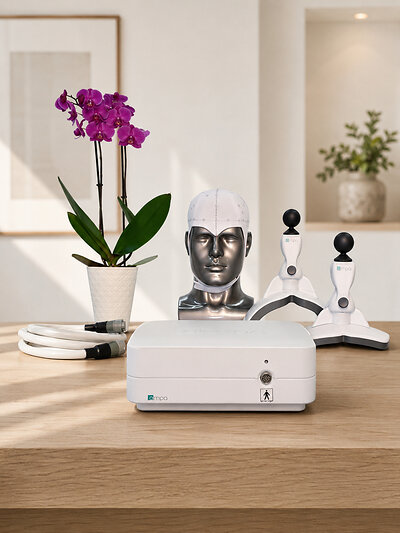
Ampa exists because too many clinics that wanted to offer TMS looked at the numbers and walked away. A new system historically meant a six-figure purchase or a per-session fee that never stopped accruing, a treatment room dedicated to a single large cart, and a protocol that asked patients to show up daily for six weeks. Each of those barriers made sense on its own, given how the technology developed. Together, they kept TMS out of reach for a lot of practices that wanted to offer it and a lot of patients who needed a non-drug option. Ampa One is our answer: a compact, US-made TMS system built around an accelerated protocol from the start, with navigation included and a leasing model that removes the per-session fee. This piece is about why we built it that way.
August 13, 2026
What Is TMS Neuronavigation? Camera-Based and MRI-Based Targeting Explained
Neuronavigation is the set of technologies used to position a TMS coil at the same spot on a person's head, consistently, from one session to the next. Because a TMS coil's effect is concentrated in a relatively small area of tissue (see how a TMS coil works), even small shifts in coil placement can mean the field is being delivered to a slightly different location than intended. Neuronavigation systems solve this by tracking the coil's position relative to the head in real time, ranging from simple physical landmarks to camera-based tracking to full MRI-based mapping.This is fundamentally a targeting and workflow question, not a treatment-outcome question—it's about how precisely and repeatably a coil can be returned to the same location, which is an engineering property of the positioning system rather than of the treatment itself. Ampa One includes camera-based neuronavigation as a standard part of its system, at no added hardware cost, which places it at a specific point along a broader spectrum of targeting approaches.
August 13, 2026
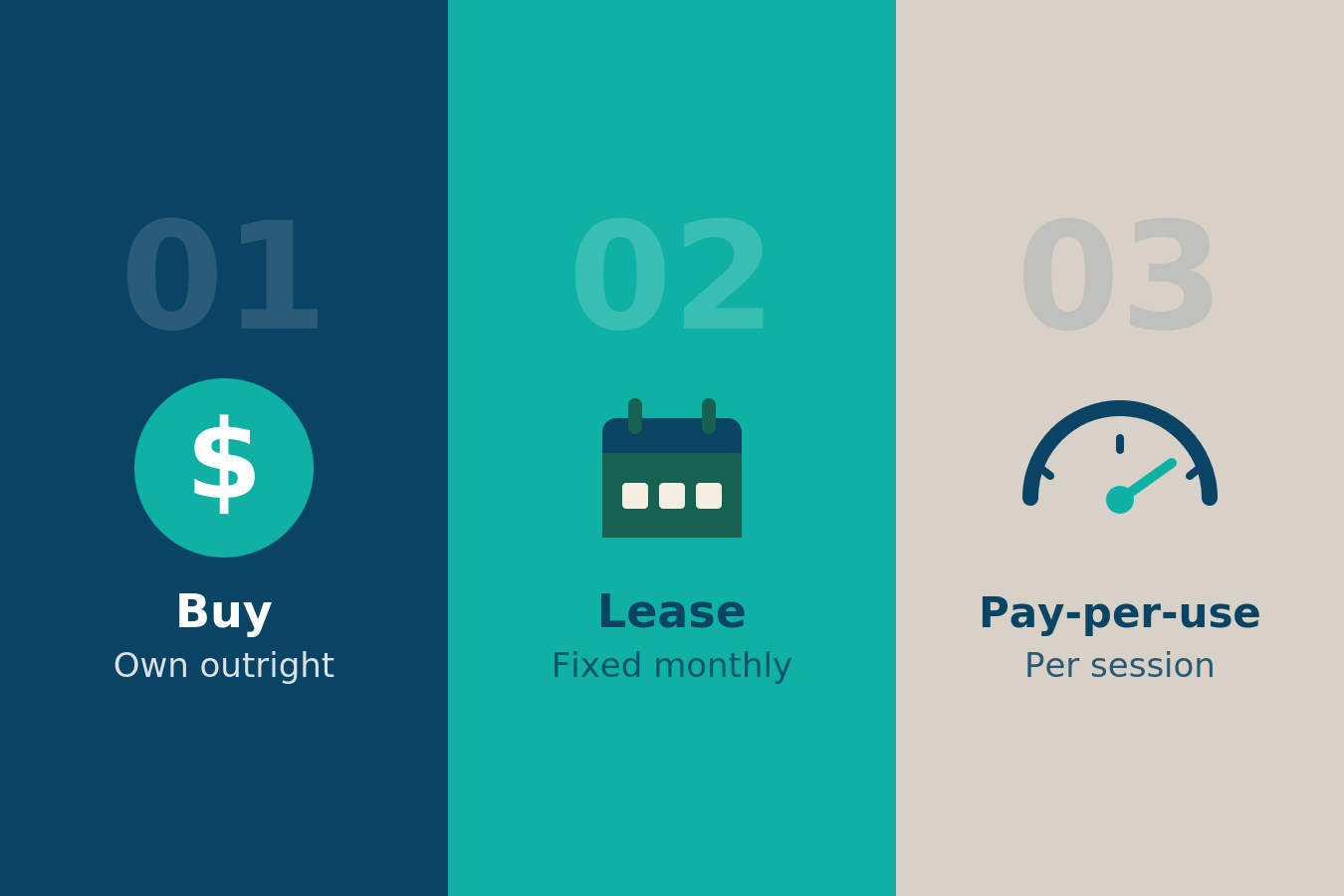
TMS Business Models Compared: Lease vs. Buy vs. Pay-Per-Use
How you acquire a TMS device matters as much as which device you choose, because the acquisition model sets your cost structure for years. The same protocol delivered on the same coil can be highly profitable or barely break even depending on whether you bought the system, lease it, or pay the manufacturer for every session. This guide compares the three models, shows how to model your own break-even, and gives you a framework for choosing your first device.
August 13, 2026
Accelerated TMS as a Practice Differentiator
Accelerated TMS compresses a course of treatment that traditionally spans six weeks into a handful of days. For patients, that can mean relief in a fraction of the time. For a practice, it is also a genuine competitive differentiator — a way to stand out in a market where most clinics still offer the same six-week protocol on legacy hardware. This guide explains what accelerated TMS is, why it changes the economics and appeal of a program, and how to position it.
August 13, 2026
Staffing and Training a TMS Program: Roles, Timelines, and Avoiding the Staffing Gap
Most TMS programs succeed or fail on staffing, not technology. A practice can choose the right device, prepare the room, and secure reimbursement, and still stall before its first treatment because no one was ready to run the machine. This guide covers the roles a TMS program needs, how quickly operators can be trained on modern systems, and how to avoid the staffing gap that quietly derails new programs.
August 11, 2026
FDA-Cleared TMS Devices Compared: Ampa One, NeuroStar, BrainsWay, MagVenture & Magstim
Five major FDA-cleared TMS devices compete with distinct coil types, treatment protocols, and business models. NeuroStar dominates market share but uses costly pay-per-use fees. BrainsWay offers the broadest indication coverage with H-coil technology. MagVenture provides modular research flexibility with liquid cooling. Magstim combines heritage with competitive pricing and included navigation.Ampa One enters as the clinician-designed option built specifically for accelerated TMS protocols, featuring camera-based navigation and dual coil types (L and M) in a compact form factor. No single device wins every category. Your choice depends on practice workflow, target indications, and business model preferences.The comparison table below consolidates key specifications for quick reference.