
Single-day TMS regimens with pharmacological augmentation of plasticity: Five cases
Accelerated regimens for transcranial magnetic stimulation (TMS) may allow fewer clinic visits while preserving/improving outcomes (Chen et al., 2023). Historically, the first reported accelerated TMS regimen achieved 43 % response following 1.5 days of treatment (Holtzheimer et al., 2010). However, no subsequent work has revisited the effectiveness of such rapid TMS regimens. An updated single-day TMS regimen could apply evidence-based adjustments from recent literature: a 30-min intersession interval (Ramos et al., 2025) allows 20 sessions in <10 h; 20 sessions of TMS augmented with D-cycloserine has achieved remission rates >70 % in major depressive disorder (MDD) (DeMayo et al., 2025) and YBOCS reductions ∼10 points in obsessive-compulsive disorder (OCD) (McGirr et al., 2025); preclinical (Enomoto et al., 2015) and clinical (Wilke et al., 2022) TMS studies also support dopaminergic/psychostimulant augmentation; add-on right orbitofrontal stimulation may enhance/accelerate treatment response (Cui et al., 2024). Combining such optimizations could potentially maximize effectiveness of a single-day TMS intervention.
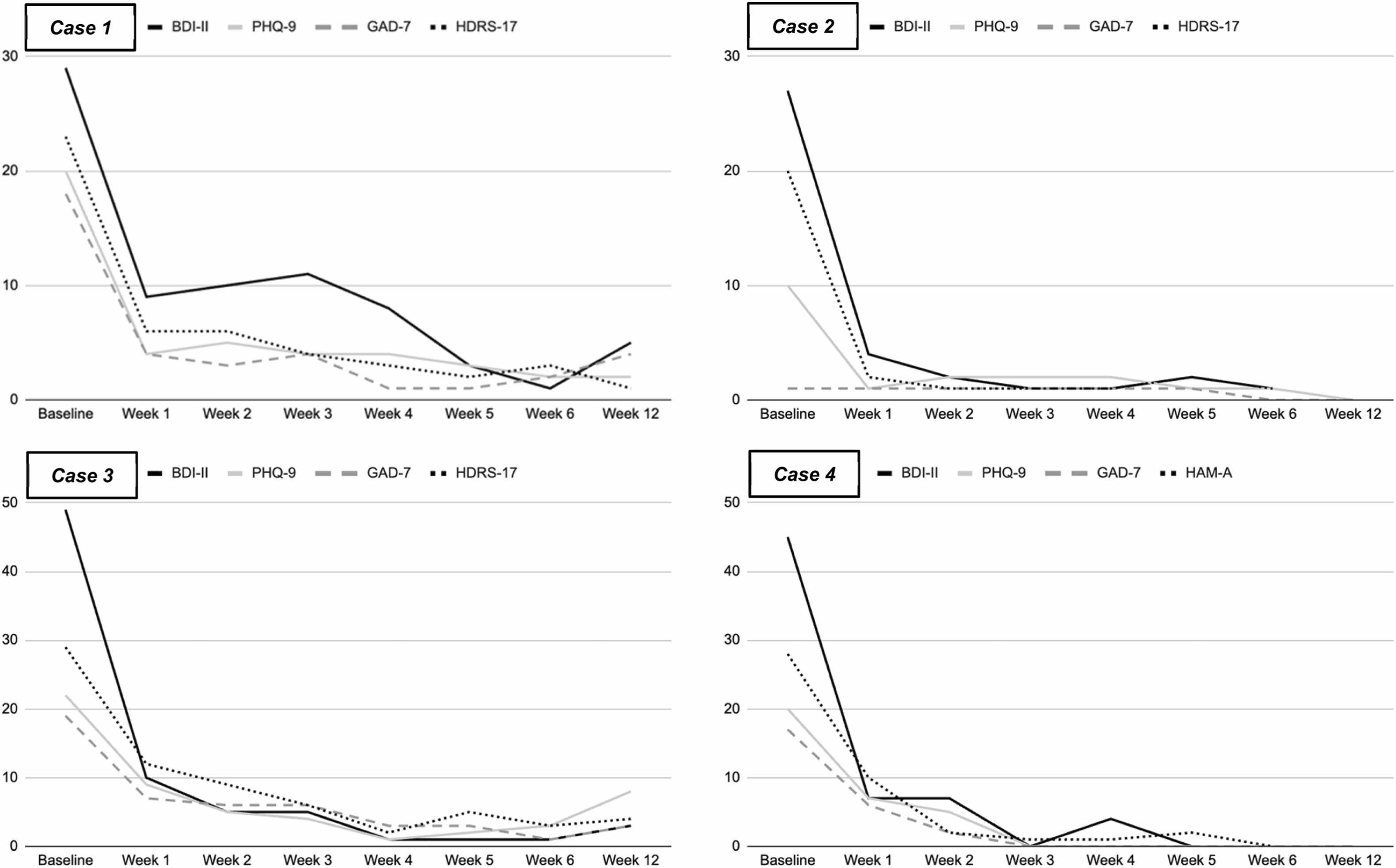
Here we report clinical outcomes for five patients who were logistically unable to attend a conventional ∼30-visit TMS course, but did consent to off-label treatment with a single-day, pharmacologically-augmented TMS regimen. Each individual patient consented to report de-identified clinical outcomes. Patients described here were either the first for whom their specific regimen was applied in their specific set of comorbidities (Cases 2, 4, 5), or the first of such for whom longer-term (≥12 week) follow-ups were available (Cases 1, 3). Symptom scales are presented in Table 1 and Fig. 1, with additional clinical details in Supplementary Material.
Table 1
Clinical outcomes for single-day TMS regimens, Cases 1–5. Three notable features of the therapeutic response are evident: i) although all 20 sessions were delivered in a single day in each case, the actual therapeutic response was delayed by 1–6 weeks and in some cases did not reach maximum effect until 6 weeks post-treatment; ii) the response appeared durable out to 3–6 months in every case where data was available; iii) the response was not confined to depression alone but also applied to comorbid anxiety and OCD symptoms, when present.
TMS, transcranial magnetic stimulation; MDD, major depressive disorder; GAD, generalized anxiety disorder; ADHD, attention-deficit/hyperactivity disorder; OCD, obsessive-compulsive disorder; DCS, D-cycloserine; LDA, lisdexamfetamine; DLPFC, dorsolateral prefrontal cortex; DMPFC, dorsomedial prefrontal cortex; rOFC, right orbitofrontal cortex; HDRS-17, Hamilton Depression Rating Scale, 17-item; HAM-A, Hamilton Rating Scale for Anxiety; BDI-II, Beck Depression Inventory-II; PHQ-9, Patient Health Questionnaire, 9-item; GAD-7, Generalized Anxiety Disorder rating scale, 7-item; iTBS600, intermittent theta-burst stimulation, 600 pulses; cTBS600, continuous theta-burst stimulation, 600 pulses; Fz and FP2 refer to scalp sites defined according to the international 10–20 EEG montage; PF3 refers to the more posterior of the two left DLFPC scalp sites referenced in Mir-Moghtadaei et al., 2022 after Siddiqi et al., 2021.
Case 1: 48-year-old otherwise-healthy, TMS-naive man, with DSM-V diagnoses of MDD and generalized anxiety disorder (GAD), previous failed trials of bupropion, fluoxetine, and sertraline, off medications for 5 years due to inefficacy, presented with baseline HDRS-17 of 23 and PHQ9 of 15. On assessment day, he received 20 mg lisdexamfetamine and 125 mg DCS compounded oral disintegrating tablet (cODT); 60 min later, he underwent 20 sessions of TMS, initiated q 30 min, using iTBS600 at 120 % RMT, targeting left dorsolateral prefrontal cortex (site ‘PF3’, Supplementary Material). 1 week post-treatment followup revealed remission at HDRS-17 = 6 and PHQ9 = 4, with improvement sustained at week 12 (HDRS-17 = 1, PHQ9 = 2) and week 26 (HDRS-17 = 6, PHQ9 = 5) despite no further TMS treatment, psychotherapy, or pharmacotherapy.
Case 2: 52-year-old TMS-naive woman, DSM-V diagnosis of MDD (onset in adolescence) and comorbid binge eating disorder and diabetes, with a current depressive episode of 5 years’ duration, unresponsive to trials of sertraline, fluoxetine, bupropion, dextromethorphan-bupropion, duloxetine and brexpiprazole, presenting with baseline HDRS-17 of 20 and BDI-II of 27. On assessment day, she received 20 mg lisdexamfetamine and 125 mg DCS cODT; 60 min later, she underwent 20 sessions of TMS, initiated q 30 min, each session targeting dorsomedial prefrontal cortex (site Fz), iTBS600 at 100 % lower extremity RMT followed immediately by right orbitofrontal cortex (site FP2), cTBS600 at 100 % upper extremity RMT. Scores at 1 week post-treatment indicated remission (HDRS-17 = 2; BDI-II = 4), sustained at week 6 (HDRS-17 = 1; BDI-II-1) and week 24 (HDRS-17 = l) despite no further intervention via TMS, pharmacotherapy, or psychotherapy.
Case 3: 31-year-old, otherwise-healthy, TMS-naive woman with a history of MDD (onset, age 17) and 2 episodes of postpartum depression 9 and 11 years ago; the current episode of 4 years’ duration was unresponsive to fluoxetine 30 mg daily x 12 months, and trazodone 50 mg qhs x 7 months. She presented with baseline HDRS-17 of 29 and BDI-II of 49. On assessment day she received 20 mg lisdexamfetamine and (due to lack of access to D-cycloserine) 6300 mg of D-serine (∼80 mg/kg); 60 min later, she underwent 20 sessions of TMS, initiated q 30 min, each session targeting 3 sites sequentially: dorsomedial prefrontal cortex (site Fz), iTBS600 at 100 % lower extremity MT; right orbitofrontal cortex (site FP2), cTBS600 at 100 % upper extremity MT; left DLPFC (site ‘PF3’), iTBS600 at 120 % upper extremity MT. Response ensued 1 week post-treatment (HDRS-17 = 12; BDI-II = 10), progressing to remission by week 3 (HDRS-17 = 6; BDI-II = 5), sustained out to week 12 (HDRS-17 = 4; BDI-II = 3).
Case 4: 55-year-old, otherwise-healthy, TMS-naive woman meeting DSM-V criteria for GAD (onset, age 19), MDD, and ADHD, previously unresponsive to escitalopram and sertraline, presented with a baseline HAM-A of 28 and PHQ9 of 20. She underwent a single-day regimen of 20 sessions of left DLPFC-TMS (site ‘PF3’), starting q 30 min, iTBS600 at 120 % RMT, with 125 mg DCS cODT (without lisdexamfetamine) pre-administered 60 min before session 1. Response was evident at 1-week followup (HAM-A = 10; PHQ9 = 9), progressing to remission by 3 weeks (HAM-A = 1; PHQ9 = 0), and sustained at 12 weeks (GAD-7, PHQ-9, BDI-II = 0).
Case 5: 51-year-old, otherwise-healthy, TMS-naive woman meeting DSM-V criteria for OCD and MDD (current episode, 4 years), with minimal response to pharmacotherapy, presented with severe contamination obsessions and symmetry/neatness compulsions, a baseline YBOCS of 26 and PHQ9 of 15. She underwent a single-day regimen of 20 sessions of iTBS600, starting q 30 min, targeting dorsomedial prefrontal cortex (site Fz) at 100 % lower extremity MT, with 125 mg DCS cODT and 20 mg lisdexafetamine, pre-administered 60 min before session 1. Followup revealed marked improvement at 1 week (YBOCS = 7 and PHQ9 = 1), sustained at 12 weeks (YBOCS = 7, PHQ9 = 1) and 26 weeks (YBOCS = 9, PHQ9 = 3), with full resolution of compulsive eye-/ear-cleaning and preoccupations over dirt/contaminants, despite no further intervention via TMS, pharmacotherapy, or psychotherapy.
Notably, each case showed temporal dissociation between the single-day intervention and the subsequent delayed response: full effect in some cases required 6 weeks, but was sustained for 3–6 months without further intervention. This dissociation reduces the apparent contribution of non-specific behavioral activation/therapeutic contact to the eventual response. Other notable points include use of a different NMDA receptor agonist (D-serine rather than DCS) in Case 3, omission of lisdexamfetamine in Case 4, and marked, durable improvement in comorbid OCD in Case 5.
Although these observations are preliminary, the magnitude and durability of response suggest it may be worthwhile replicating/disconfirming the effectiveness of plasticity-augmented, single-day TMS regimens in larger standardized case series and randomized sham-controlled trials. Safety and efficacy considerations for DCS, D-serine, and other adjuvants also bear future comparative study (cf. Kantrowitz et al., 2010). Single-day regimens with confirmed safety and preserved effectiveness would increase TMS accessibility, particularly for patients in remote areas. Emerging TMS indications involving mobility impairment could also become more practical with single-day regimens, in future studies.

© 2025 Ampa Inc. All rights reserved.