TMS ROI: How to Model Your Practice's Break-Even
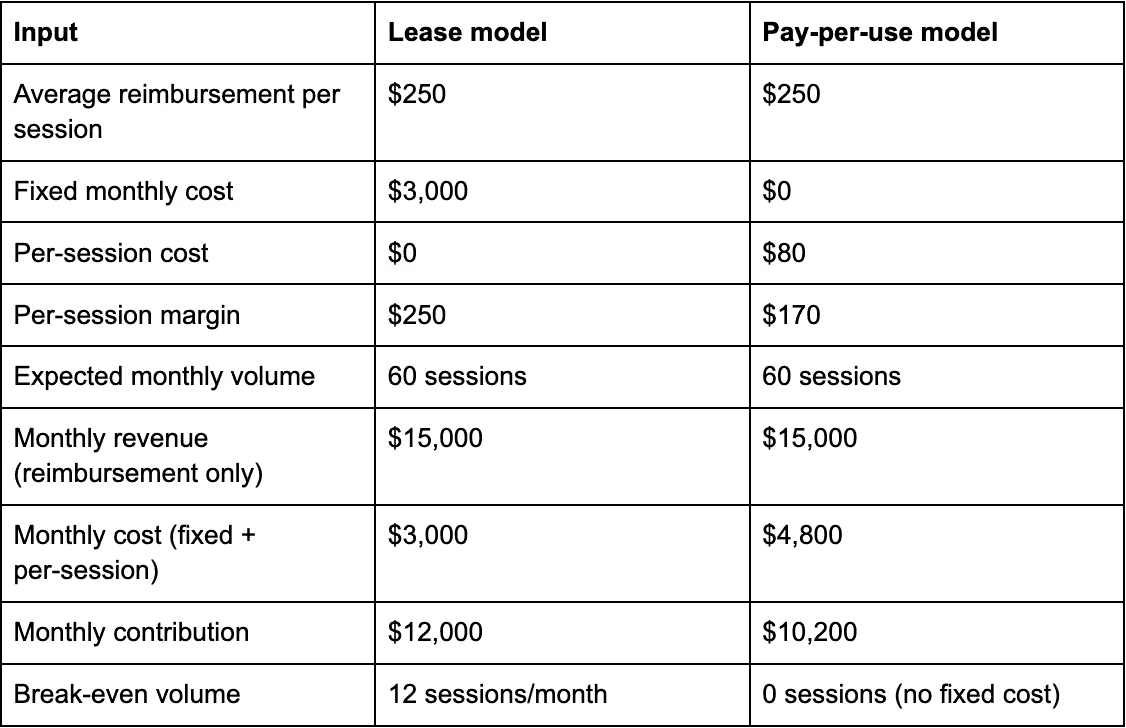
You can model whether a TMS program will pencil out for your practice with four inputs: your average reimbursement per session, your fixed monthly cost, your per-session cost, and your expected monthly session volume. Once you have those four numbers, a single formula tells you the session volume at which the program breaks even, and the same formula lets you compare acquisition models like lease versus pay-per-use at your own realistic volume. This guide walks through each input, gives you the formula in plain language, and works a clearly labeled illustrative example.
Why model break-even before choosing a TMS acquisition model?
The acquisition model you choose, whether outright purchase, a monthly lease, or a per-session manufacturer fee, sets your cost structure for as long as you run the program. A model that looks affordable at low volume can compress your margin badly at higher volume, and a model that looks expensive upfront can produce a stronger long-run margin once you clear break-even. Modeling the numbers before signing an agreement lets you choose the structure that fits your actual patient flow rather than the one that sounds simplest at signup. For a full comparison of the three acquisition models, see TMS Business Models Compared.
What is the first input: average reimbursement per session?
This is what your payer mix actually pays for a TMS session, net of patient copays, not the billed or list rate. Because reimbursement varies by payer, plan, and region, pull your own figure from your practice's billing data or from direct conversations with your top payers rather than relying on a published average. If you are new to TMS billing, ask your billing team or a reimbursement consultant to estimate a blended rate across your expected payer mix, and revisit that number once you have real claims data. See CPT Codes and Reimbursement Basics for TMS for background on how TMS sessions are billed and coded.
What is the second input: fixed monthly cost?
Your fixed monthly cost includes whatever you pay regardless of how many sessions you deliver that month. Under a lease, this is the monthly lease payment. Under a purchase, this is the amortized monthly cost of the device, spreading the upfront purchase price across its expected useful life, since a large one-time cost needs to be converted into a monthly figure to compare fairly against a lease. Add relevant overhead to either figure, such as the portion of room space, technician time, and administrative support dedicated to the TMS program, so your fixed cost reflects the full monthly burden rather than just the equipment payment.
What is the third input: per-session cost?
This is the cost that scales directly with volume, separate from your fixed monthly cost. Under a lease or an outright purchase, the per-session cost is typically zero, since there is no additional manufacturer fee once you have the device. Under a pay-per-use arrangement, the manufacturer charges a fee for every session delivered, commonly in the range of $60 to $100, which is subtracted from your reimbursement on every single visit for as long as you use the device.
What is the fourth input: expected monthly session volume?
This is your realistic forecast of how many TMS sessions your practice will deliver each month, based on how many patients you expect to have in active treatment concurrently. Because a single patient's course runs roughly 30 to 36 sessions over four to six weeks, even a small number of concurrent patients can generate a meaningful monthly session count. Build this estimate conservatively for your first few months and revise it once you have real referral and scheduling data, since overestimating volume is the most common way a break-even model turns out to be too optimistic.
What is the break-even formula, in words?
Your monthly contribution equals your reimbursement per session, minus your per-session cost, multiplied by your number of sessions that month, minus your fixed monthly cost. Break-even is the session volume at which that contribution reaches zero. Put another way: figure out your margin on each session after subtracting any per-session fee, then divide your fixed monthly cost by that per-session margin to find how many sessions you need to cover your fixed costs in a given month. Every session beyond that point contributes directly to your program's monthly profit.
Worked example (illustrative numbers only)
The table below compares a lease model against a pay-per-use model at the same example session volume. All figures are round numbers chosen for illustration and are not real reimbursement rates, lease prices, or manufacturer fees. Confirm your own numbers with your payers and any device vendor before modeling your practice's real economics.
Input (Illustrative)
Lease model
Pay-per-use model
Average reimbursement per session
$250
$250
Fixed monthly cost
$3,000
$0
Per-session cost
$0
$80
Per-session margin
$250
$170
Expected monthly volume
60 sessions
60 sessions
Monthly revenue (reimbursement only)
$15,000
$15,000
Monthly cost (fixed + per-session)
$3,000
$4,800
Monthly contribution
$12,000
$10,200
Break-even volume
12 sessions/month
0 sessions (no fixed cost)
In this illustrative example, the lease model requires roughly 12 sessions a month to cover its fixed cost, and every session after that contributes the full $250 margin. The pay-per-use model has no fixed cost to cover, so it breaks even immediately, but it never reaches the same per-session margin, since $80 comes off the top of every single visit forever. At an example volume of 60 sessions a month, the lease model produces a higher monthly contribution than the pay-per-use model, and that gap widens further as volume grows, which is the pattern described in more detail in TMS Business Models Compared.
How does this change at different volumes?
The comparison above holds at one example volume, but the relationship between the two models shifts as volume changes, so it is worth running the same table at a low-volume and a high-volume scenario for your own practice. At low volume, a lease's fixed cost can be harder to cover, while pay-per-use avoids that risk since there is no fixed payment to meet regardless of how few sessions you deliver. At high volume, the lease's full per-session margin compounds quickly, while pay-per-use's per-session fee keeps subtracting from every visit no matter how large your program grows. Modeling your own numbers at a conservative volume and an optimistic volume gives you a realistic range rather than a single point estimate. Accelerated protocols, which compress a course into fewer calendar days, can also change your effective monthly volume; see Accelerated TMS as a Practice Differentiator for how that factors into program economics.
What if you want something more automated than this worksheet?
The formula and table above are built to work with a spreadsheet or even a calculator and a notepad, using your own reimbursement, cost, and volume figures in place of the illustrative ones here. An interactive ROI calculator that accepts these same four inputs and generates a break-even chart automatically could be a useful next step for practices that want to compare several acquisition models or volume scenarios side by side without rebuilding the table each time.
Frequently Asked Questions
What four inputs do I need to model TMS break-even? Average reimbursement per session, fixed monthly cost, per-session cost, and expected monthly session volume. Gather your reimbursement figure from your own billing data and your fixed and per-session costs from your device agreement, then apply the break-even formula described above.
How do I turn a device purchase price into a fixed monthly cost? Amortize the purchase price over the device's expected useful life, then add monthly overhead such as room space and staff time dedicated to the program. This produces a monthly figure you can compare directly against a lease payment.
Is a lease or pay-per-use better for a new TMS program? It depends on your expected volume and risk tolerance. A lease typically requires covering a fixed monthly cost but preserves full per-session margin afterward, while pay-per-use has no fixed cost to cover but reduces margin on every session indefinitely. Model both at your own realistic volume before deciding, and see TMS Business Models Compared for a fuller discussion.
How many sessions do I need per month to break even? It depends entirely on your fixed monthly cost and your per-session margin. Divide your fixed monthly cost by your reimbursement per session minus any per-session fee to find your break-even volume, then compare that figure against your realistic patient flow.
Where do I get an accurate reimbursement-per-session figure? Pull it from your own practice's claims data once you have billing history, or ask your billing team and top payers directly if you are new to TMS. Published averages are a starting point only; your actual blended reimbursement depends on your specific payer mix.
Should I model best-case, worst-case, or average volume? Model all three if possible. A conservative volume scenario tells you the minimum patient flow you need to avoid losing money, while an optimistic scenario shows how quickly a strong model can become profitable. Comparing acquisition models across a range of volumes gives a more honest picture than a single projection.
The figures in this guide are illustrative examples only, not real reimbursement rates or device pricing, and this article is not financial advice. Confirm your own numbers with your payers and device vendor before making business decisions.
Meet the TMS system built for what’s next
Ampa One brings accelerated protocols, precision neuronavigation, a compact footprint, and a flexible subscription model together in one streamlined TMS platform.