How Does a TMS Coil Work? The Physics Behind Magnetic Brain Stimulation

TL;DR
Straightforward physics explainer: how a TMS coil generates its field via electromagnetic induction, the three system components (stimulator, coil, positioning), why the skull doesn't block the field, pulse strength/depth, why TMS counts as non-invasive, and how coil geometry (figure-8 vs. H-coil, tying back to Ampa's L/M coils) shapes the field. No efficacy or indication claims anywhere — it's mechanism-only.
Table of Contents
- What are the three main components of a TMS system?
- What is electromagnetic induction, in plain terms?
- Why doesn't the magnetic field get blocked by the skull?
- How strong are the pulses, and how deep do they reach?
- Why is TMS considered non-invasive?
- How does coil shape affect the magnetic field?
Transcranial magnetic stimulation (TMS) uses a coil of wire to generate a rapidly changing magnetic field just outside the scalp. That field passes through the skull without resistance and induces a small electrical current in the brain tissue directly beneath it. No incision, no implant, and no anesthesia are involved. The magnetic field does the work from outside the head.
The underlying principle is electromagnetic induction, the same physics used in transformers and induction cooktops, just applied at a small scale and pointed at a very specific target. Understanding the three parts of a TMS system (the stimulator, the coil, and the positioning system) makes it easier to see how a treatment session actually works at the level of physics and engineering.
What are the three main components of a TMS system?
A TMS system has three functional parts that work together, each with a distinct job.
The stimulator is essentially a high-power electrical capacitor and switching system. It charges up and then discharges very quickly, sending a brief, intense pulse of current through the coil. The speed of that discharge is what matters most; TMS depends on how fast the current changes, not just how much current flows.
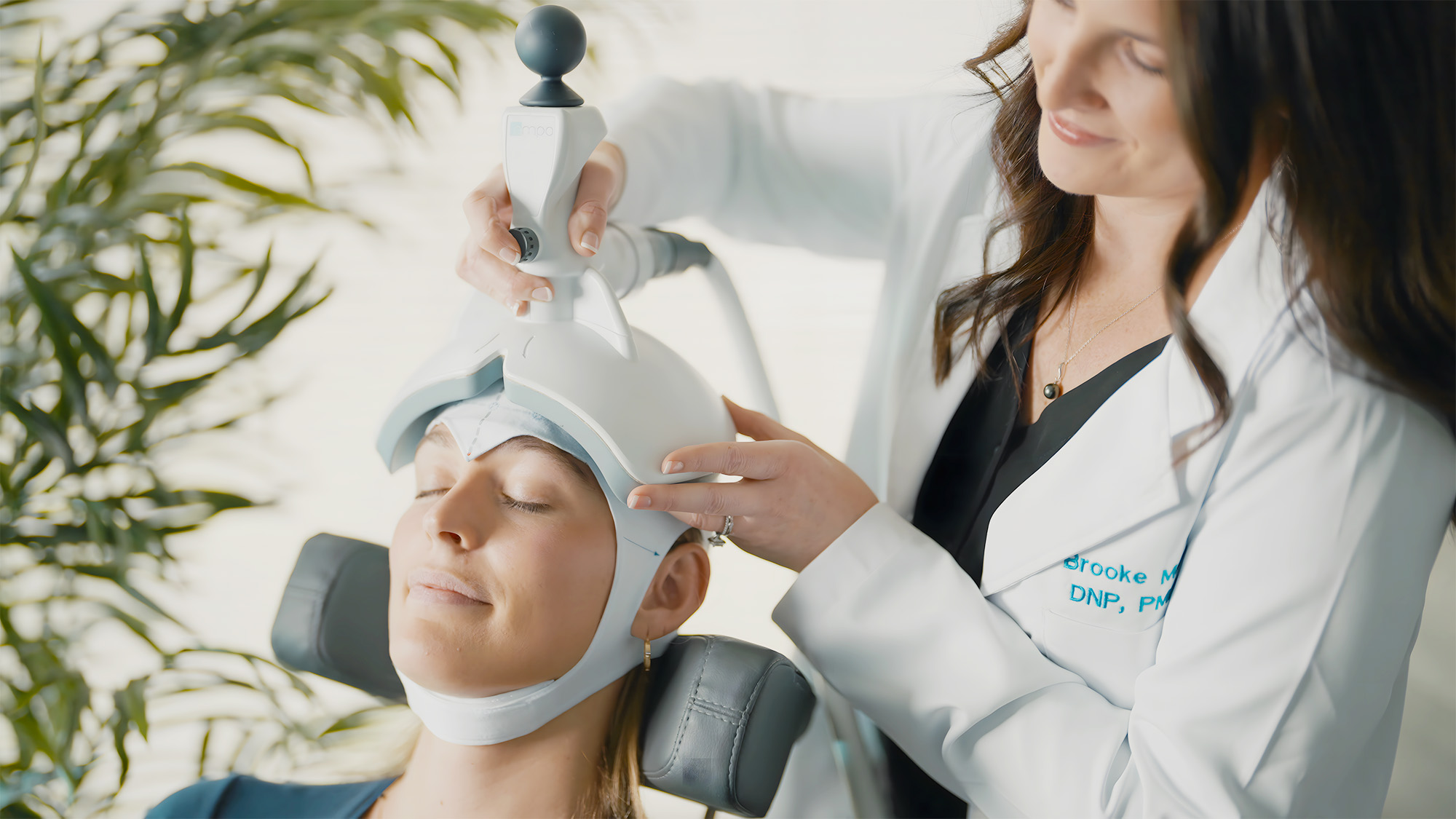
The coil is the part that actually sits against the scalp. It's a shaped loop (or set of loops) of insulated wire, encased in plastic, designed to convert that pulse of current into a magnetic field with a specific shape and focus. Different coil geometries shape the field differently, which is why coil design is such a central engineering variable in TMS (see our comparison of figure-of-8 and H-coil designs).
The positioning system ensures the coil is placed at the same spot on the head, session after session. This can range from simple external landmarks to camera-based or MRI-based neuronavigation, which tracks the coil's position relative to the person's head in real time.
What is electromagnetic induction, in plain terms?
Electromagnetic induction is the phenomenon where a changing magnetic field creates an electrical current in a nearby conductor and brain tissue, like other biological tissue, conducts electricity.
Here's the sequence in a single TMS pulse: the stimulator sends a burst of current into the coil, which builds a magnetic field almost instantly. Because that field appears and disappears within a fraction of a millisecond, it changes very rapidly. That rapid rate of change is what induces a small electrical current in the tissue beneath the coil, not the magnetic field's strength alone, but how quickly it rises and falls.
This is the same basic principle discovered by Michael Faraday in the 1830s: a moving or changing magnetic field induces current in a nearby conductor. TMS applies that principle at a scale and location precise enough to influence a small volume of tissue near the surface of the brain.
Why doesn't the magnetic field get blocked by the skull?
Bone, skin, and scalp tissue have very low magnetic permeability resistance, meaning magnetic fields pass through them essentially unimpeded. This is different from how these tissues handle electrical current directly. Skin and bone actually resist electrical current fairly well, which is part of why older forms of direct electrical brain stimulation required much higher energy or invasive access to be effective.
By routing the stimulation through a magnetic field instead of directly through electrodes on the skin, TMS sidesteps that resistance. The field passes through unimpeded and only becomes an electrical current once it reaches the conductive tissue of the brain itself.
How strong are the pulses, and how deep do they reach?
TMS coils generate magnetic field pulses on the order of up to roughly 2 Tesla at the coil face - a strength comparable to, or greater than, the fields used in clinical MRI machines, though delivered very differently (a brief pulse versus a sustained field).
The induced electrical effect is strongest near the coil and drops off with distance, which is a basic property of magnetic field physics: field strength decreases sharply as you move away from the source. In practice, this means standard TMS coils primarily influence tissue within about 2 to 3 centimeters of the scalp surface, which corresponds to the outer layers of the cerebral cortex. This is a physical property of coil-generated fields, not a design limitation unique to any one manufacturer.
Why is TMS considered non-invasive?
TMS is classified as non-invasive because nothing crosses the skin barrier and no surgical access is required. The coil rests against the outside of the head, and the magnetic field does the work of reaching the tissue underneath. There's no incision, implanted hardware, or need for anesthesia or sedation, since the scalp and skull are not being cut, punctured, or electrically stimulated directly.
This is a meaningful engineering distinction from implanted neurostimulation devices, which do require surgery to place electrodes in or on the brain. TMS achieves targeted stimulation entirely through field physics delivered from outside the body.
How does coil shape affect the magnetic field?
The geometry of the coil's wire windings determines the shape of the magnetic field it produces, which in turn determines how concentrated or spread out the induced current is in the underlying tissue.
A simple circular coil produces a fairly broad, unfocused field. Shaping the windings into a figure-8 pattern concentrates the field where the two loops meet, producing a more focal effect over a smaller area, roughly the size of a coin. Other geometries, like the H-coil design, use a different winding pattern to spread the induced current across a broader region. All coils are governed by the same basic depth-versus-distance physics. What primarily changes is the width of the area affected. This design trade-off (and how Ampa One's L and M coils apply it) is covered in more detail in our article on figure-of-8 versus H-coil designs.
Frequently Asked Questions
Is a TMS coil magnetic all the time, or only during a pulse? Only during a pulse. The coil is not a permanent magnet; it generates a magnetic field only when the stimulator sends current through it, and that field exists for a fraction of a millisecond per pulse.
Does the person feel the magnetic field itself? The magnetic field itself isn't felt directly, but the induced current in scalp muscles and nerves can produce a tapping or clicking sensation at the site of stimulation. This is a byproduct of the pulse's effect on superficial tissue, not the magnetic field passing through bone.
Why does TMS make a clicking sound? The rapid electrical discharge into the coil causes the coil's internal components to vibrate slightly, producing an audible click with each pulse. This is a mechanical byproduct of the fast electrical switching, similar to the sound a transformer can make.
Is TMS the same technology as an MRI machine? They rely on related electromagnetic principles but serve very different purposes. MRI uses a strong, stable magnetic field plus radio pulses to produce images, while TMS uses brief, rapidly changing pulses to induce current in tissue. The field strengths can be in a similar range, but the way the field is applied and its purpose are different.
Does coil design affect treatment protocols like accelerated TMS? Coil design and stimulation protocol are related but separate engineering choices. Protocols like accelerated TMS schedules are about pulse timing and session frequency rather than coil geometry. See our article on accelerated TMS as a differentiator for more on how protocol design factors into a TMS system.
Can I feel where the magnetic field is reaching inside my brain? No. The induced current inside brain tissue itself is not something a person can consciously feel. Any sensation during treatment comes from effects on the scalp, skull muscles, or nearby nerves, not from the underlying neural effect the device is intended to produce.
This article is for general educational purposes only and is not medical advice. For questions about whether TMS is appropriate for you, consult a qualified clinician.

Meet the TMS system built for what’s next
Ampa One brings accelerated protocols, precision neuronavigation, a compact footprint, and a flexible subscription model together in one streamlined TMS platform.

How to Find a TMS Provider Near You

Can You Use an HSA or FSA for TMS Therapy?