FDA-Cleared TMS Devices Compared: Ampa One, NeuroStar, BrainsWay, MagVenture & Magstim
TL;DR: Choosing a TMS device comes down to matching coil type, session length, navigation, and business model to how your practice runs — no single system wins on every axis. This guide compares the five FDA-cleared systems on the market: Ampa One, NeuroStar, BrainsWay, MagVenture, and Magstim. Ampa One's subscription-based model prioritizes speed and simplicity (3-minute sessions, no per-session fees, included navigation); NeuroStar and BrainsWay carry the broadest indication portfolios; MagVenture and Magstim lead on navigation-platform compatibility and field history, at higher upfront cost.
Table of Contents
- What Is TMS?
- How We Evaluated These Devices
- Ampa One
- NeuroStar (by Neuronetics)
- BrainsWay
- MagVenture
- Magstim
- The Bottom Line
- Why Ampa One Stands Out for Modern TMS Practices
Choosing among TMS devices that hold FDA clearance comes down to matching a device to your practice's indication mix, patient volume, and financial model. This guide compares the five most established FDA-cleared systems against various clinical and business criteria including coil design, session length, navigation and business model. No device wins every category. Each carries trade-offs that land differently depending on how your practice runs.
What Is TMS?
Transcranial magnetic stimulation (TMS) delivers focused magnetic pulses to targeted brain regions through the skull, with no surgery and no anesthesia. The magnetic field temporarily changes neural activity in specific cortical areas, giving patients a non-pharmaceutical treatment for psychiatric conditions such as treatment-resistant depression.
Every TMS system has three core parts: a pulse generator that produces the magnetic pulses, a coil that focuses the field, and a positioning system that targets the correct brain region. The stimulator generates brief, powerful pulses up to 2 Tesla and the coil directs that energy roughly 2 to 3 centimeters into brain tissue.
Two coil families dominate the market. Figure-of-8 coils create focal stimulation in an area about the size of a quarter. H-coils produce more diffuse stimulation across a wider region with less precision. On session length, standard TMS runs 19 to 37.5 minutes, while iTBS compresses a comparable dose of stimulation into about 3 minutes; clinical trials have generally found the two approaches comparable in outcomes. FDA clearance is granted indication by indication with a specific set of stimulation parameters, and no single device is cleared for every condition, so the right device depends on your patient population and treatment goals.
How We Evaluated These Devices
We compared each device on six criteria that shape both patient outcomes and daily operations. FDA clearance breadth determines which conditions you can treat. Coil type affects ease-of-use & precision. The field form figure-of-eight coils is more focal, while double-cone coils cover a wider, more diffuse one. Session length drives the biggest workflow difference between devices, since a 3-minute session and a 37.5-minute session mean very different daily patient counts. Neuronavigation ranges from none, to an included camera system, to MRI-compatible options. Business models vary from purchase to leasing to pay-per-use to a monthly subscription. delivered. We also weigh ease of use, technical support, and warranty terms, all of which shape long-term operating cost.
Device Comparison At A Glance
Last verified September 16, 2026
1. Ampa One
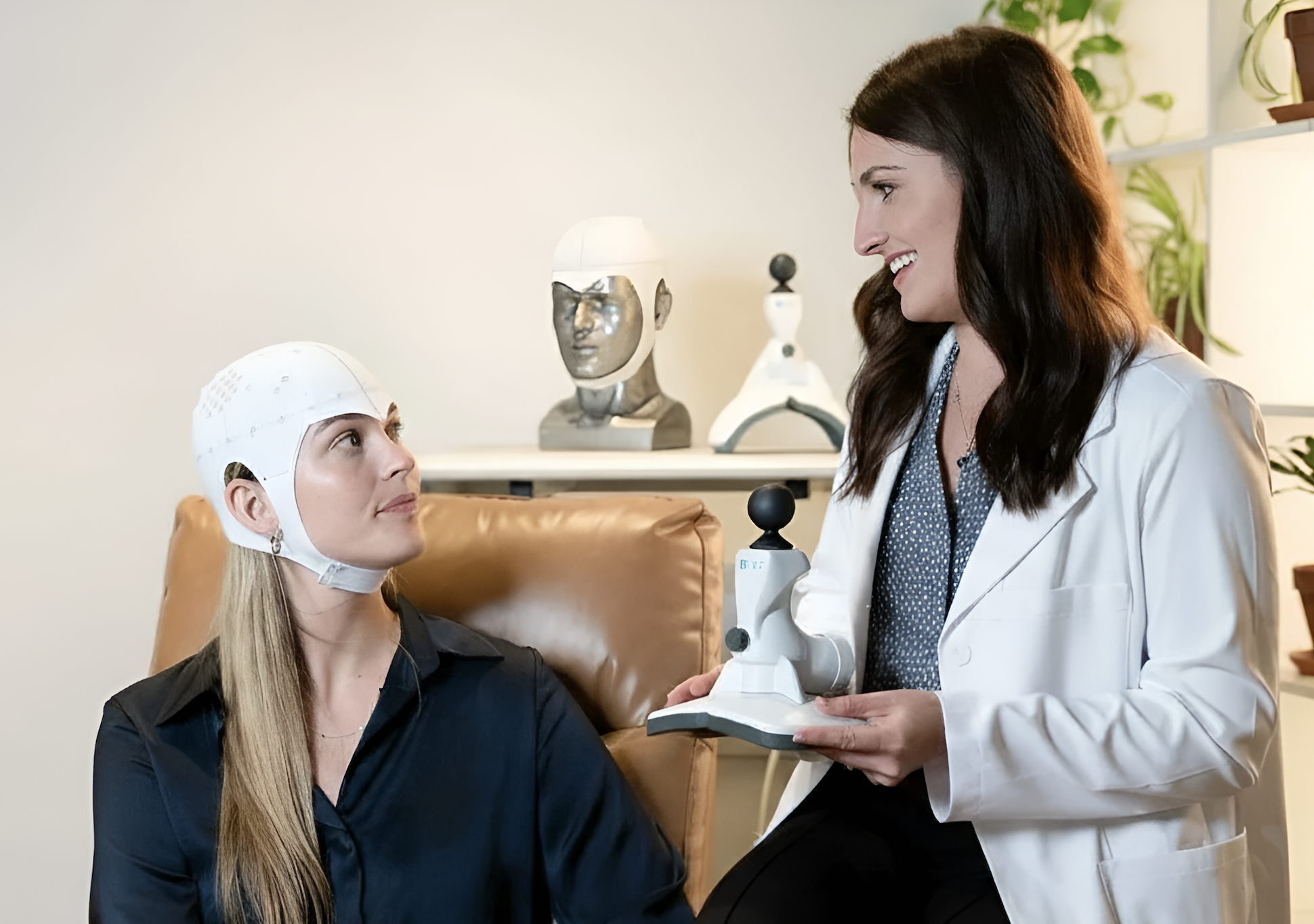
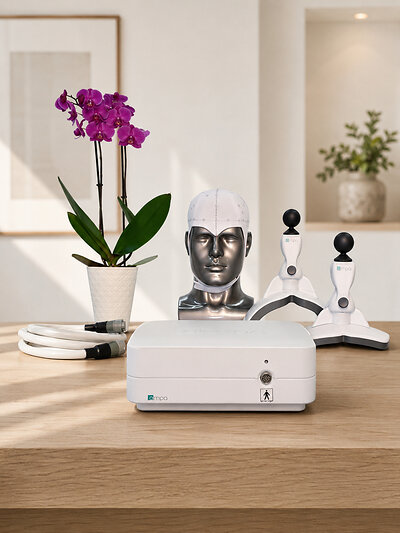
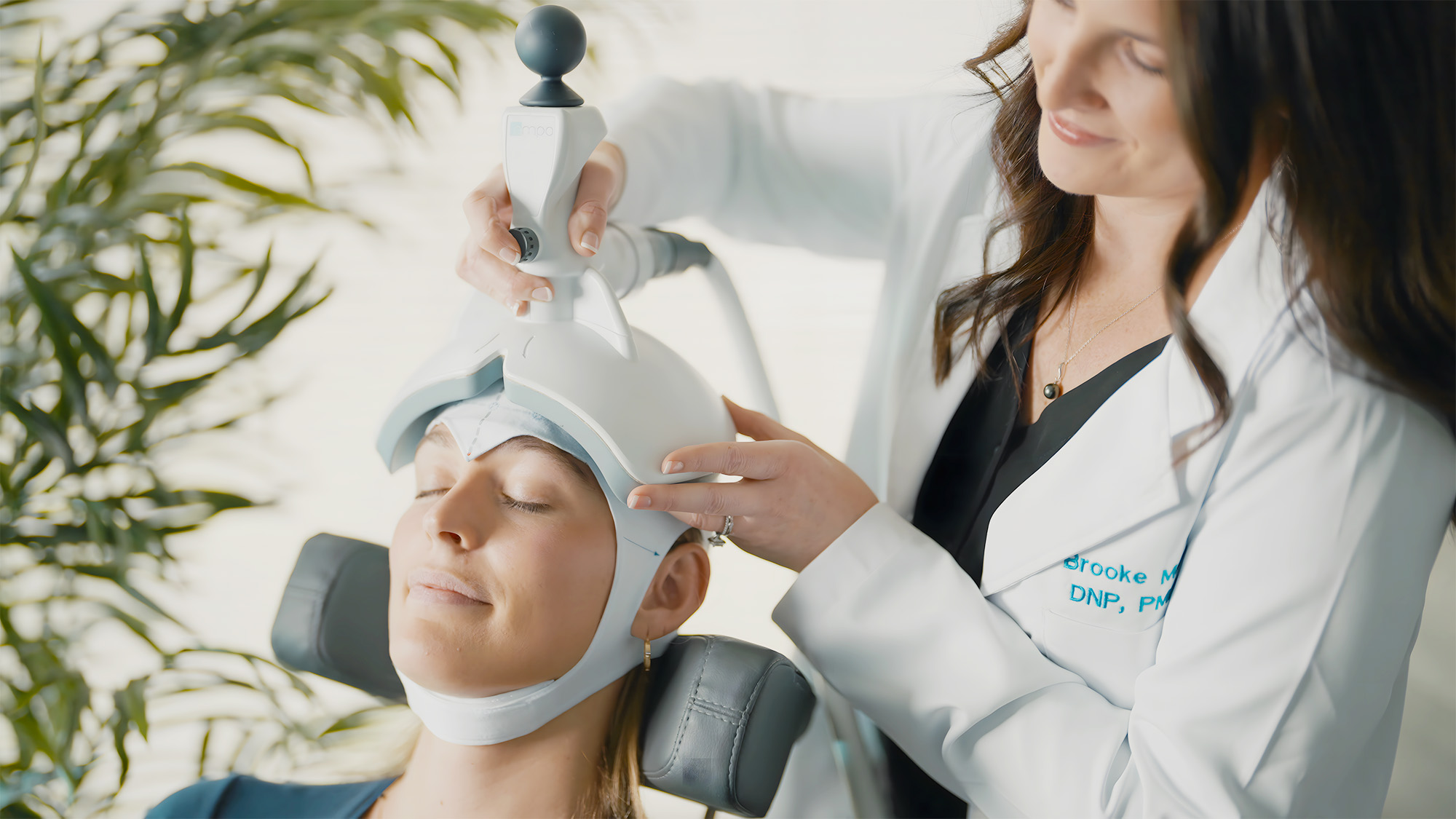
Quick overview: Ampa One is a US-based system with a clinician-designed system around workflow efficiency. It offers two coils: the L coil for focal stimulation, comparable to a figure-of-8, and the M coil for deep stimulation, substantially equivalent to BrainsWay's H7. Ampa One is cleared to deliver intermittent theta burst stimulation (iTBS), which puts Ampa One's fastest session at about 3 minutes. The coil weighs only 2 pounds and includes camera-based, AI-enabled neuronavigation that halts stimulation automatically if the coil moves off target. Clinics report a training ramp of a few hours before staff start treating patients. The system is stowable in 2 pelican cases and can be transported between rooms and sites.
Best for: Practices that expect high patient volume, want a simple workflow, and would rather not commit to an upfront equipment purchase or a dedicated treatment room. Ampa One isn't available for outright purchase; it's a subscription of $3,000 per month, with no long-term contract or per-session fees. The subscription includes installation, operator training, and worn out coil replacements, repairs, and certain software and hardware upgrades.
Pros. Ampa One supports accelerated programs. Integrated camera-based navigation removes the add-on cost that other devices charge for precise targeting. Two coils, focal (L) and diffuse (M), let a practice address different stimulation needs without buying separate systems. The compact, portable design needs less space than cart-based systems, and clinicians report shorter training curves thanks to the simplified interface. iTBS clearance enables 3-minute sessions rather than the 19–37.5 minute protocols older systems require. Ampa's proprietary thermal technology allows back-to-back treatments with a lightweight coil without downtime. The system is stowable in 2 pelican cases and can be transported between rooms and sites. Ampa One plugs into a regular 15 amp outlet, removing the traditional need to electrically rewire circuits for 20 amps on most other machines.
Cons. Ampa One is not available for purchase; it’s only available through a subscription model.
Pricing. Ampa One operates exclusively on a subscription model: $3,000/month, which includes shipping, training, repair, warranty, and replacement for worn-out parts. There are no per-session, coil replacement, or upgrade fees. Pricing comparisons between Ampa and other platforms should factor in coil replacement costs.
2. NeuroStar (by Neuronetics)
Quick overview. NeuroStar was the first FDA-cleared TMS device in the United States, approved in 2008. It uses a traditional figure-of-8 coil with three protocol options: Standard (37.5 minutes), DASH (19 minutes), and the newer TouchStar iTBS (3 minutes). NeuroStar has accumulated extensive outcomes data through its NeuroStar Advanced Therapy registry. The device uses Contact Sensing technology to verify coil placement rather than neuronavigation, prioritizing consistency with anatomical landmarks over individualized MRI-based targeting.
Best for. Practices that prioritize established commercial entities and extensive existing outcomes tracking.
Pros. NeuroStar offers a broad FDA clearance portfolio covering major depressive disorder, OCD, anxious depression, and adolescent depression for patients 15 and older. It benefits from long-window clinical validation across thousands of treatments and a large outcomes registry. Neuronetics provides thorough training. Because of its early market entry, many TMS-trained technicians already have NeuroStar experience.
Cons. The pay-per-use model charges practices $60–$100 per session for their proprietary disposable, directly reducing margin and creating an ongoing financial relationship with Neuronetics. NeuroStar lacks neuronavigation, relying on landmark-based positioning. Requires a 20 amp circuit in the treatment room.
Pricing. Pay-per-use, with session fees of $60–$100 charged separately from device acquisition. Purchase price approx. $120K. Contact Neuronetics directly to verify current device pricing.
3. BrainsWay
Quick overview. BrainsWay uses proprietary H-coils built into a helmet to deliver what the company has trademarked as "Deep TMS" through diffuse stimulation. The Israel-based manufacturer offers coil variants for specific indications: H1 for depression, H7 for OCD, and H4 for smoking cessation. BrainsWay received accelerated TMS FDA clearance in September 2025.
Best for. Practices treating diverse populations including nicotine cessation that have room for a dedicated TMS suite.
Pros. BrainsWay holds the widest FDA indication portfolio, covering major depression, anxious depression, OCD, and smoking cessation. It is the only TMS device cleared for late-life depression in patients aged 22–86, addressing a gap in geriatric psychiatry.
Cons. H-coils are incompatible with full-brain neuronavigation, which limits or encumbers targeting possibilities compared with figure-of-8 alternatives. Because the diffuse pattern activates a wider area of tissue, some patients may find stimulation uncomfortable. Requires a 20 amp circuit in the treatment room.
Pricing. Capital expenditure of approx. $150k — $200k. Contact BrainsWay directly to verify current device pricing.
4. MagVenture
Quick overview. MagVenture built commercial TMS systems out of Denmark starting in 1992 and earned the first US iTBS clearance in 2018 from Ampa co-founder Dr. Jonathan Downar’s clinical trial data. The company builds systems with liquid cooling (Cool D-B80 for OCD) that prioritize modularity and research compatibility. MagVenture integrates with more neuronavigation platforms than any competitor, which makes it a common choice for academic and research-heavy practices.
Best for. Research-oriented practices or sophisticated clinics that need modular coil options and comprehensive neuronavigation compatibility.
Pros. MagVenture's 2018 iTBS clearance gave it a two-year head start on accelerated protocols. Liquid cooling enables quiet operation and back-to-back scheduling without thermal downtime on its R30 model. The system supports Atlas, Localite, Brainsight, Vizor2, and Soterix neuronavigation platforms, a compatibility range no other device matches.
Cons. Significant capital expenditure of typically $100k+. Warranty packages are not included by default. Liquid cooling demands maintenance vigilance, and a cooling failure can sideline the device. More lightweight options like the R20 have forced cooldown lockouts and cannot sustain a constant treatment load. The cart-based design consumes more floor space than compact alternatives. The clinical unit, the R30, requires a 20 amp circuit in the treatment room.
Pricing. Capital expenditure of approx. $100k+. Contact MagVenture directly to verify current device pricing.
5. Magstim
Quick overview. Magstim brought TMS therapy to market in 1990, making it the world's first commercial TMS company. The UK-based manufacturer offers air-cooled figure-of-8 coils through its Horizon Performance and newer H3 systems, both paired with StimGuide neuronavigation. FDA clearances cover MDD (both rTMS and iTBS), anxious depression, and OCD.
Best for. Practices that want navigation capability without the complexity of MRI-based targeting and that value the 35 years of field history.
Pros. Magstim's 35-year commercial TMS history gives it the longest field experience of any manufacturer. Air cooling eliminates downtime between patients, since the coil cools fast enough for immediate back-to-back sessions. StimGuide navigation comes included and uses anatomical landmarks rather than MRI uploads, which reduces workflow complexity. Clinicians consistently praise the technical support and warranty coverage.
Cons. Landmark-based StimGuide cannot incorporate patient-specific MRI data for enhanced targeting accuracy. Air cooling also generates more noise than liquid-cooled alternatives, which some patients find uncomfortable during sessions. Magstim requires a larger physical footprint than smaller, more modern machines and it’s not a budget option. Requires a 20 amp circuit in the treatment room.
Pricing. Capital expenditure of approx. $150k+. Contact Magstim directly to verify current device pricing.
The Bottom Line
No single device wins across every category. Ampa One's short sessions, included navigation, and flat subscription with no per-session fees suit practices built around simple workflows and patient throughput, with the tradeoff that the device isn't available for outright purchase.
NeuroStar and BrainsWay bring the broadest indication portfolios and the deepest outcomes data. NeuroStar also ties your margin to a per-session fee that runs indefinitely.
MagVenture and Magstim offer strong navigation options and long field histories, at a higher upfront cost or larger footprint.
Why Ampa One Stands Out for Modern TMS Practices
Ampa One is designed for high patient throughput and easy staff training. Ampa One's accelerated scheduling comes from how its L coil, included camera navigation, and subscription model were built to work together, not retrofitted onto a system designed for the standard 6-to-8-week course. The 3-minute session length, navigation included at no extra hardware cost, and a training ramp measured in hours instead of days all point toward the same design goal: more patients seen per day without adding staff or floor space.
Most TMS devices require neuronavigation as a separate purchase, and commercial systems typically run $30,000 to $100,000 on their own. Ampa One includes camera-based coil positioning as standard equipment, which lowers both the upfront cost of adding TMS and the complexity of training staff on a second system.
Space is the other practical barrier. Ampa One's compact form factor fits into a standard exam room, without the footprint of a cart-based system, and doesn’t require the electrical circuitry to accommodate a 20 amp plug as many other devices. Together this allows a clinic to add TMS without a dedicated procedure suite or major facility changes.
On the business side, Ampa One isn't a lease, it's a subscription: month-to-month, cancel anytime. That structure removes the six-figure capital outlay that most other systems require before a clinic can treat its first patient, which is what makes advanced TMS accessible to practices that couldn't otherwise justify the investment. And because there's no per-session fee, daily patient volume isn't capped by a per-treatment charge, and clinics keep the full margin on every treatment instead of splitting it with the manufacturer.
To see whether Ampa One's streamlined approach fits your clinic, you can get in touch with our sales team.
Frequently Asked Questions
What is TMS? Transcranial magnetic stimulation delivers focused magnetic pulses to targeted brain regions through electromagnetic coils, offering a non-pharmaceutical treatment for conditions like major depressive disorder, obsessive-compulsive disorder (OCD), adolescent depression, anxious depression, and smoking cessation. Ampa One is FDA-cleared for treatment resistant depression in adults.
What is the difference between rTMS and iTBS? rTMS (most often abbreviated to TMS) delivers standard protocols lasting 19–37.5 minutes per session. iTBS is a form of rTMS that uses theta-burst patterns to achieve comparable clinical efficacy in 3-minute sessions. Ampa One is FDA-cleared specifically for iTBS and supports accelerated TMS programs.
Do TMS devices require neuronavigation? Navigation improves targeting precision but is not required for FDA-cleared protocols. NeuroStar and BrainsWay use landmark-based coil placement without navigation. Ampa One includes camera-based navigation and MagVenture and Magstim support frameless stereotaxy options.
How long does a TMS course take? TMS courses have traditionally been spread across 36 days. Newer accelerated protocols allow an entire course to be completed in as little as one week, or even more recently, one day. The course is composed of 20 to 36 individual treatment sessions. Initially these sessions ran for 37.5 minutes; later the DASH protocol reduced it to 19 minutes, and, since 2018 the iTBS protocol accomplishes the same efficacy as the prior protocols in only 3 minutes.

Meet the TMS system built for what’s next
Ampa One brings accelerated protocols, precision neuronavigation, a compact footprint, and a flexible subscription model together in one streamlined TMS platform.

Can You Use an HSA or FSA for TMS Therapy?

How to Find a TMS Provider Near You