What to Expect During Your First TMS Session: The Mapping Process, Sensations, and What's Different About Day One
TL;DR
The first TMS session isn't like the ones that follow it. Before any treatment pulses are delivered, the clinician has to determine your motor threshold, the calibration step that sets your personal dose, and position the coil precisely. This piece covers that process, what the pulses actually feel like, and why day one runs longer than a routine visit. Mechanism and procedure only. No claims about how well treatment works, just what happens and what it feels like. For the logistics of getting to that first appointment, see How to Prepare for Your First TMS Appointment.
Table of Contents
- The first session
- Motor threshold determination
- How does the clinician find and lock in the coil position?
- The mapping process
- What happens when treatment starts
- What does a TMS pulse feel like?
- Session length
- What to tell your provider
Most of what happens during a first TMS session is invisible from the waiting room: a short calibration step that determines exactly how much stimulation your brain needs. Everything covered here is the clinical portion of that visit. For what to bring and how to plan your day around it, see How to Prepare for Your First TMS Appointment.
How is the first session different from every session after it?
Every TMS session after the first follows a fairly fixed routine: the clinician positions the coil at your predetermined target and delivers the protocol. The first session adds one step before any of that: figuring out what "your" dose actually is. That calibration step, called motor threshold determination, is what makes day one longer and slightly different in feel from the sessions that follow.
What is motor threshold determination, and why does it happen on day one?
Motor threshold is the minimum amount of stimulation needed to produce a visible physical response, typically a small twitch in the hand, when the coil is positioned over the part of the brain that controls hand movement. The clinician delivers single pulses at gradually adjusted intensity over that region until they find the lowest level that reliably produces a twitch. That number becomes the baseline your treatment protocol is calculated against, since TMS dosing is set as a percentage of an individual's own threshold rather than a fixed intensity for everyone.
This step happens because the motor threshold varies meaningfully from person to person. Dosing off someone else's threshold, or a generic average, would either under-stimulate or over-stimulate the intended target. It's done once, at the start of a course, and clinicians typically only briefly reverify it at later sessions rather than repeating the full process.
How does the clinician find and lock in the coil position?
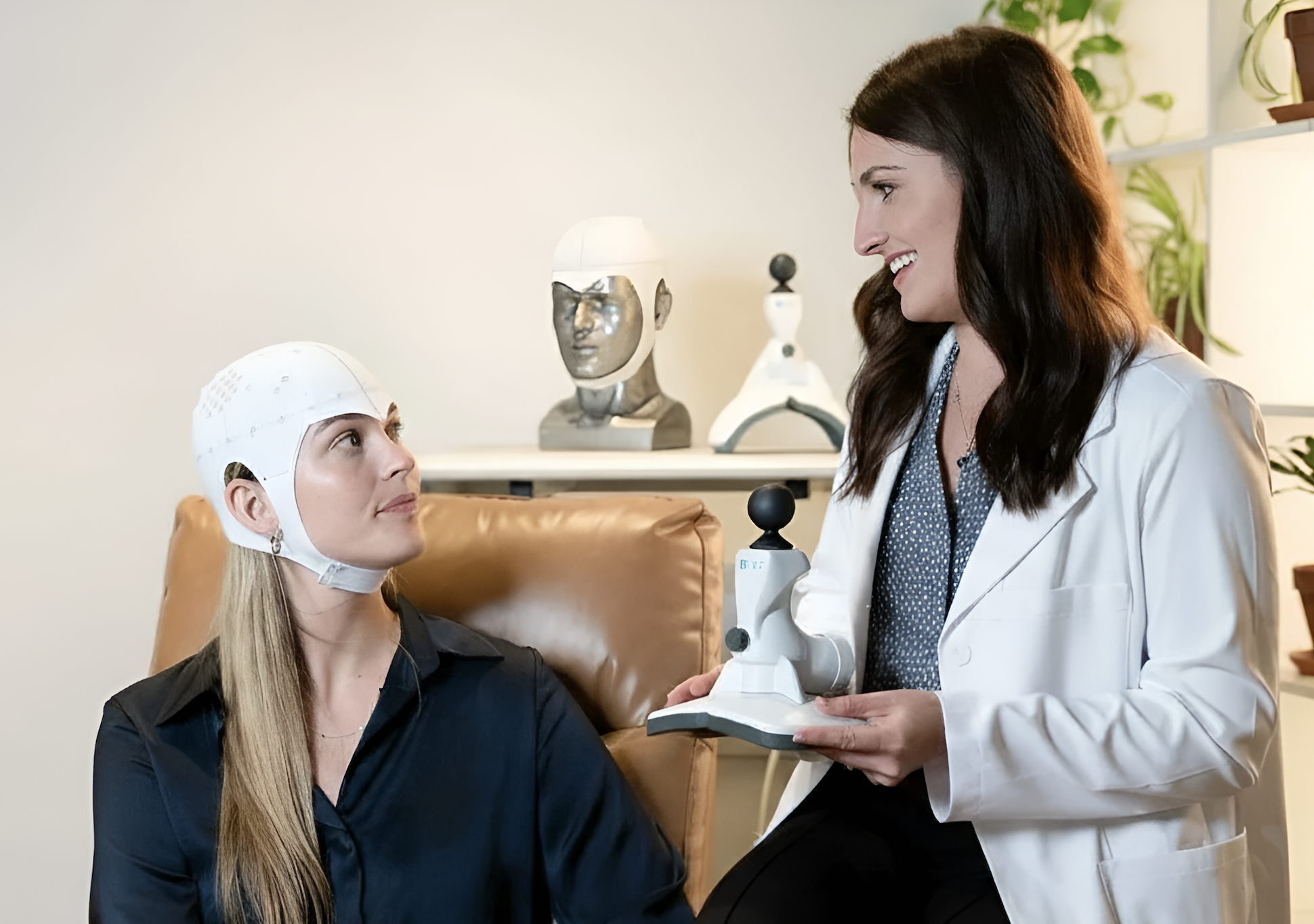
Once your threshold is set, the clinician needs to make sure the coil lands on the correct target region session after session, since the treatment target is a different location from the hand-motor area used for thresholding. Ampa One does this with a camera built into the coil itself, which visually confirms the coil's position against a fitted Neuronavigation Cap sized to your head. The clinician may use an Ampa One feature called Target Lock to help ensure the coil only delivers pulses at the prescribed target.
The practical effect for you is that setup takes a few extra minutes on day one while the system establishes that reference point, but it means every subsequent session can return to the same spot quickly and consistently.
What does the mapping process actually feel like?
During thresholding, you'll feel a series of individual pulses, each a brief tapping or clicking sensation at the scalp, similar to what you'll feel during treatment itself but delivered one at a time rather than in rapid trains. Some clinics provide earplugs or earphones because the coil makes a clicking sound with each pulse. Generally the presence of these clicks requires attention to hearing protection for both operators and patients. During the session, you'll likely notice your hand or fingers twitching involuntarily each time the clinician finds a pulse strong enough to trigger a response. That twitch is the intended readout of the process, not a side effect to be concerned about.
What happens once treatment itself starts?
Once your threshold is set and the coil is positioned at your treatment target, the clinician starts the actual protocol. Depending on which protocol you're on, this looks different: a standard rTMS session delivers pulses over roughly 3 minutes. You'll hear the same clicking sound throughout, now in a repeating rhythm rather than single spaced-out pulses, and feel the same tapping sensation at the treatment site rather than at the hand.
What does a TMS pulse feel like, and what's normal to feel?
In standard practice most people describe the sensation as a tapping or knocking feeling on the scalp, sometimes with mild discomfort. It's common to notice this most in the first few sessions before it becomes more familiar. Mild headache and temporary discomfort at the stimulation site are the most frequently reported effects industry-wide, and both are generally described in the clinical literature as short-lived and manageable with an over-the-counter pain reliever if needed. If a sensation feels sharper or more uncomfortable than expected, that's worth saying out loud in the moment: clinicians can adjust the coil's position, lower the amplitude, or pause briefly, since comfort during a session is something the provider actively manages rather than something you have to just tolerate. There are additional risks associated with TMS that may change the sensation of TMS therapy discussed within TMS Therapy Safety and Side Effects.
You'll remain fully awake and able to talk throughout, since TMS doesn't involve sedation or anesthesia. Mayo Clinic and Cleveland Clinic both describe TMS sensations in similar terms: noticeable but generally well-tolerated, with side effects tending to ease as a course progresses. As with any medical procedure, less common reactions are possible, and your specific risk profile is something to go over with your prescribing clinician before starting, not something covered by this overview.
How long does the first session take, start to finish?
Budget more time than you would for a routine visit. Between intake, motor threshold determination, and coil positioning, the first session commonly runs 15 minutes longer than the treatment protocol alone would take. A clinic offering the theta burst protocol, for example, might have you there for closer to 30 to 35 minutes on day one even though the treatment itself only takes 3 minutes. Later sessions drop back down to roughly the protocol length once the setup work is behind you.
What should I tell my provider during the session?
Speak up about anything that feels more uncomfortable than expected, since that's the clinician's cue to adjust intensity or reposition the coil. It's also worth mentioning if you feel lightheaded, unusually anxious, or if a sensation seems to be spreading beyond the treatment site rather than staying localized. None of this is a sign that something has gone wrong; it's the normal feedback loop that lets a clinician fine-tune your sessions, particularly early in a course before things settle into a routine.
Frequently Asked Questions
Does motor threshold determination hurt more than regular treatment? Not typically. It involves single, spaced-out pulses rather than the rapid trains used in treatment, and most people find it comparable to or milder than the sensation of a full session.
Will I need motor threshold testing every time? No. It's established in full on day one and only briefly reverified at later sessions, not repeated from scratch.
Can I drive myself home after my first session? Yes. TMS doesn't involve sedation, so most patients drive themselves to and from every session, including the first. see How to Prepare for Your First TMS Appointment for more on planning the day around it.
What if I can't tolerate the sensation at my calculated threshold? Tell your clinician. Intensity and coil position can be adjusted for comfort, and some clinics start slightly below full intensity in the first week and increase it as tolerated.
Why does the treatment target differ from where my threshold was measured? Motor threshold is measured over the hand-motor region because it produces an observable response (the twitch) that's useful for calibration. The actual treatment target, commonly the dorsolateral prefrontal cortex, is a different location associated with mood regulation, and your dose there is calculated as a percentage of the threshold measured at the motor site.
This article is for general educational purposes only and is not medical advice. The Ampa One System is indicated for the treatment of Major Depressive Disorder in adult patients who have failed to achieve satisfactory improvement from previous anti-depressant medication treatment in the current episode. Your specific experience, protocol, and any side effects should be discussed with your treating clinician.

Meet the TMS system built for what’s next
Ampa One brings accelerated protocols, precision neuronavigation, a compact footprint, and a flexible subscription model together in one streamlined TMS platform.


What Is TMS Neuronavigation? Camera-Based and MRI-Based Targeting Explained

TMS Therapy Cost — A guide to Pricing, Insurance, and Financing