TMS Business Models Compared: Lease vs. Buy vs. Pay-Per-Use
How you acquire a TMS device matters as much as which device you choose, because the acquisition model sets your cost structure for years. The same protocol delivered on the same coil can be highly profitable or barely break even depending on whether you bought the system, lease it, or pay the manufacturer for every session. This guide compares the three models, shows how to model your own break-even, and gives you a framework for choosing your first device.
The three ways to acquire a TMS device
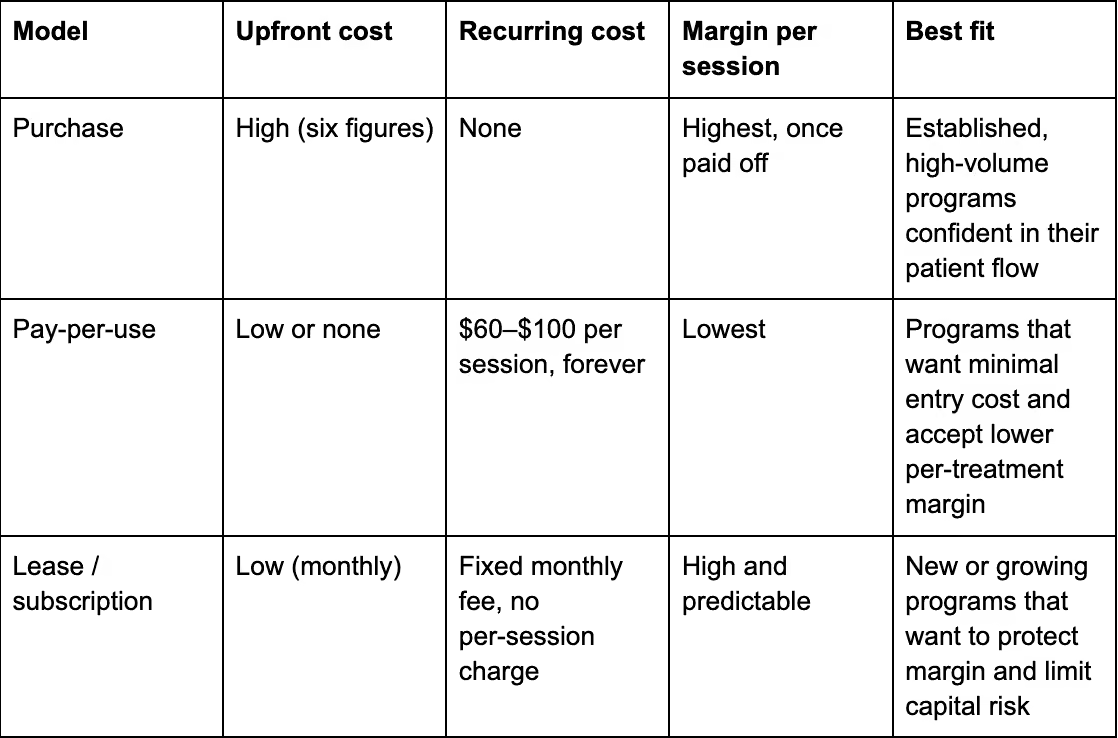
Outright purchase. You pay a large upfront cost — often well into six figures for a new system — and own the device. After that, there is no recurring manufacturer fee, so every session you bill is yours. The trade-off is capital risk: if your volume comes in lower than projected, you have already spent the money.
Pay-per-use. You acquire the device for little or nothing upfront, and the manufacturer charges a fee, commonly $60–$100, for every session you deliver. This lowers the barrier to entry but permanently reduces your margin on each treatment and ties you to an ongoing financial relationship with the manufacturer. Over a full course of 30–36 sessions, those fees add up to thousands of dollars per patient.
Leasing (subscription). You pay a predictable monthly amount for the device with no per-session fee. This keeps upfront capital low, makes costs forecastable, and leaves your full reimbursement intact on every treatment. Month-to-month leasing arrangements also let a new program scale down or exit with limited notice if circumstances change, rather than being locked into an asset. Ampa One, for example, operates on a lease of roughly $2,700–$3,000 per month (annual versus month-to-month) with no per-session fees.
No model is universally best. A large center already running hundreds of sessions a month may earn back a purchase quickly and then enjoy the highest long-run margin. A brand-new program that cannot yet forecast volume is usually better served by a lease that caps the downside and keeps every reimbursement dollar on the table.
Why pay-per-use quietly erodes margin
Pay-per-use is the model most likely to surprise a practice, because the cost is invisible at signup and only shows up treatment by treatment. Consider a single patient completing a 30-session course. At $80 per session, that is $2,400 paid to the manufacturer for one patient's treatment — money subtracted directly from your reimbursement. Multiply that across every patient, every year, and the "low entry cost" becomes the most expensive model you can choose at scale. A fixed monthly lease with no per-session fee inverts that math: the more patients you treat, the more your per-treatment economics improve, because your cost is fixed while your reimbursement grows.
How to model your TMS break-even
You do not need a complex spreadsheet to estimate whether a TMS program pencils out. Four inputs drive it.
First, your average reimbursement per session — what your payer mix actually pays for a TMS treatment, net of copays. Second, your fixed monthly cost — a lease payment, or the amortized cost of a purchase, plus room and overhead. Third, your per-session cost — zero under a lease or purchase, or the manufacturer's fee under pay-per-use. Fourth, your expected session volume per month.
Your monthly contribution is: (reimbursement per session − per-session cost) × sessions − fixed monthly cost. Break-even is the session volume where that reaches zero. Because a course runs 30–36 sessions, even a handful of concurrent patients moves the number quickly. The exercise that matters most is comparing models at your realistic volume: at low volume, a lease with no per-session fee usually wins because your fixed cost is modest and your margin per session is full; at very high volume, a paid-off purchase can pull ahead. Pay-per-use rarely wins at either end once you account for the perpetual per-session drain.
Choosing your first device
Once you have settled the financial model, the device choice narrows to a few practical questions. Which FDA-cleared indications do you need to treat? What protocol do you want to offer — standard rTMS, 3-minute iTBS, or an accelerated schedule? Does the device include neuronavigation, or is it an added cost? How much space does it need? And how transparent is the manufacturer's pricing?
A useful rule: total the true cost of ownership over three years under each model, not the sticker price. A system that looks cheap upfront but carries per-session fees can cost far more than a modestly priced lease once you project your real patient volume. For a full side-by-side of the five FDA-cleared systems on coil type, protocols, navigation, and business model, see FDA-Cleared TMS Devices Compared.
Frequently Asked Questions
Is it better to lease or buy a TMS machine? It depends on volume and capital. Buying earns the highest long-run margin but requires a large upfront investment and confidence in your patient flow. Leasing keeps capital low and costs predictable, which suits new or growing programs. Pay-per-use minimizes upfront cost but reduces margin on every session indefinitely.
How much does a TMS machine cost? Purchase prices for new systems commonly run into six figures. Leasing arrangements are quoted monthly — for example, roughly $2,700–$3,000 per month for Ampa One — with no per-session fees. Pay-per-use models lower the entry cost but charge $60–$100 per session.
What is the pay-per-use TMS model, and what does it really cost? The manufacturer charges a fee for every session you deliver, typically $60–$100. Across a 30–36 session course, that is roughly $1,800–$3,600 per patient paid back to the manufacturer, which compounds as your volume grows.
How many patients do I need to break even? It varies with your reimbursement, fixed costs, and model, but because each patient completes 30–36 sessions, a small number of concurrent patients often covers a monthly lease. Model it with your own reimbursement rate and expected volume before committing.
This article is for business-planning purposes and is not financial advice. Pricing figures are illustrative ranges; confirm current terms with each manufacturer and model your own reimbursement and volume before deciding.

Meet the TMS system built for what’s next
Ampa One brings accelerated protocols, precision neuronavigation, a compact footprint, and a flexible subscription model together in one streamlined TMS platform.

How to Find a TMS Provider Near You

How to Prepare for Your First TMS Appointment: A Practical Checklist
